
The Fashion Industry’s Shift to PFAS-Free Clothing

Wednesday, May 6, 2026|Regulatory News & Updates
waterproof fabric
For decades, harmful PFAS chemicals have been widely used in clothing and textiles for water, oil and stain resistance. Now, regulators worldwide are stepping in to protect consumers. Multiple bans took effect in January 2026, with more on the way. But transitioning to safer PFAS-free alternatives won’t happen overnight.

Table of Contents:

What Are PFAS and Why Are They Used in Textiles?

PFAS (per- and polyfluoroalkyl substances) are a group of human-made chemicals widely used in textiles to impart water, oil and stain repellency, or soil release. In the apparel industry, they’ve long been valued for enhancing fabric durability and performance. Often referred to as “forever chemicals,” PFAS are highly persistent in the environment, where they can contaminate drinking water, soil, and wildlife. Mounting scientific evidence has raised concerns about their potential impact on human health, prompting growing scrutiny from scientists, regulators, and consumers.

PFAS are often found in clothing and other textile products, including:

  • Raincoats and outerwear
  • Outdoor and performance gear
  • Activewear and sportswear
  • Uniforms and workwear
  • Household textiles
  • Lab coats
  • Tents and tarps
  • Firefighter turnout gear
  • Shoes and footwear
  • Medical textiles

PFAS are used in clothing because they can help fabrics repel moisture, oil, and dirt. But that functionality comes at a cost.

Studies link PFAS exposure to immune system suppression, hormonal disruptions, fertility issues, and increased cancer risk. As awareness grows, brands and suppliers face increasing pressure to explore safer alternatives and take a proactive role in reducing PFAS use across their supply chains.

The Lifecycle of PFAS in Textiles: From Production to Pollution

According to the European Environment Agency (EEA), PFAS enter the environment at every stage of textile production, from manufacturing to disposal. Textiles are one of the largest sources of PFAS pollution worldwide, with both polymeric and non-polymeric PFAS released during production, use, and washing.

This widespread contamination is a key reason PFAS are increasingly regulated, and why brands need to take action across their supply chains. Proactive chemical management, starting at the input stage rather than relying solely on end-product testing, is essential to reduce impact and stay ahead of tightening global standards.

Regulations Are Driving PFAS Out of Fashion

As the health and environmental risks of PFAS become more widely recognized, governments worldwide are enacting stricter regulations to limit or ban their use in textiles. In 2026 alone, new PFAS restrictions took effect across multiple U.S. states and European countries, with additional deadlines approaching throughout the year.

For the fashion and textile industry, compliance is no longer a future concern. Brands and manufacturers operating across multiple markets now face overlapping requirements with different timelines, thresholds, and exemption structures. Consumers are also more aware than ever of the risks associated with PFAS, and many are actively seeking out clothing made without these chemicals.

Staying ahead of these requirements means more than monitoring legislation. It requires supply chain visibility, verified chemical data, and the ability to demonstrate compliance with confidence.

Key PFAS Bans Affecting the Textile Industry

As governments respond to health and environmental concerns, PFAS regulations affecting textiles are expanding rapidly. This regulatory overview highlights the key points, while also noting that many countries still apply exceptions, including allowances for essential use. Below is the current landscape as of May 2026.

United States PFAS Bans

Several U.S. states have enacted PFAS restrictions that directly affect textile and apparel companies. Federal action remains limited, but state-level legislation continues to accelerate.

  • California AB 1817 bans intentionally added PFAS in textiles, effective January 2025. Outdoor apparel for severe wet conditions must carry a “Made with PFAS chemicals” disclosure label. The total organic fluorine threshold drops from 100 ppm to 50 ppm in January 2027.
  • New York S.1322/A.994 prohibits apparel with intentionally added PFAS, effective January 2025. Outdoor apparel for severe wet conditions is exempt until January 2028. By January 2027, a maximum PFAS threshold will apply regardless of whether PFAS was intentionally added.
  • Colorado SB24-081 Phased approach to PFAS in outdoor clothing. Disclosure labels required for products containing PFAS. Full ban on outdoor apparel for severe wet conditions and textile articles effective January 2028.
  • Maine Title 38, §1614 Products containing PFAS: Sales prohibitions on most textile articles containing intentionally added PFAS took effect January 1, 2026. A statewide ban on all products with intentionally added PFAS is scheduled for January 2032.
  • Connecticut SB 292 (Public Act No. 24-59) PFAS disclosure requirements for outdoor apparel for severe wet conditions took effect January 2026. Additional product bans phase in from July 2026.
  • Vermont Title 9, Chapter 63, Subchapter 12A amendment H238 (Act 54): Prohibits manufacturers from making clothing and other consumer products with intentionally added PFAS, effective January 2026.
  • Minnesota HF 2310 (Chapter 60, 2023): PFAS reporting requirements under the state’s PRISM system launched January 2026, with initial reports due July 2026. A statewide ban on all products with intentionally added PFAS takes effect January 2032.
  • Washington Chapter 173-337-110 WAC: Reporting requirements for apparel intended for extreme and extended use made from leather, natural textiles, synthetic textiles, or technical textiles with intentionally added PFAS took effect January 2026. First reports are due January 2027. Apparel and accessories made from leather, natural textiles, synthetic textiles, or technical textiles may not contain intentionally added PFAS after January 1, 2027.

Additional states, including New Mexico and Pennsylvania, are advancing PFAS legislation that may take effect in 2027 and beyond. The regulatory patchwork continues to grow, making centralized chemical management increasingly important for brands selling across multiple U.S. markets.

Europe PFAS Bans

Europe is advancing PFAS regulation through both EU-wide measures and national legislation.

  • EU REACH Annex XVII, Entry 79: Restrictions on PFHxA and related substances take effect in April 2026, adding to existing bans on C9-C14 PFCAs. These apply across all EU member states.
  • EU POPs Regulation (EU) 2019/1021: The European Union regulates PFAS also through POPs Regulation which targets persistent organic pollutants. Under this framework, several PFAS, starting with PFOS, PFOA, and later PFHxS, have been added to Annex I for elimination or strict restriction, in line with updates to the Stockholm Convention.
  • EU Universal PFAS Restriction Proposal: Germany, Denmark, the Netherlands, Norway, and Sweden proposed a broad restriction on PFAS under REACH in January 2023. ECHA review is ongoing. In July 2025, the European Commission’s Action Plan for the Chemicals Industry signaled support for comprehensive PFAS restrictions, including a REACH revision.
  • France Law No. 2025-188 with Decree no 2025-1376: Bans the manufacture, import, export, and sale of PFAS-containing textiles, footwear, and waterproofing agents for consumer use, effective January 2026. Exemptions exist for personal protective equipment, technical textiles for industrial use, and clothing and footwear textiles incorporating at least 20% recycled material from post-consumer waste. The ban extends to all textiles by January 2030. Penalties include fines of up to €15,000 and €1,500 per day.
  • Denmark BEK No. 464: Bans import and sale of clothing and footwear containing total fluorine levels at or above 50 mg F/kg, effective July 1, 2026. Also covers waterproofing agents. Exemptions include professional safety clothing, PPE, medical devices, and products regulated under REACH and POPs frameworks. Recycled and reused clothing is also exempt.

PFAS restrictions are part of a broader trend in EU chemical regulation. The EU’s substances of concern framework and the upcoming ECGT Directive will further shape how brands communicate about the chemistry in their products. For more context, see Chemical Regulation Is Accelerating: Is Your Supply Chain Ready?

Challenges in Phasing Out PFAS in Clothing

While the shift away from PFAS is gaining momentum, the transition presents real challenges for textile manufacturers and brands. Moving away from established chemistries requires navigating technical, regulatory, and supply chain complexities simultaneously.

Key challenges include:

  • Performance trade-offs: Alternative treatments must match PFAS-level wash durability, water repellency, and stain resistance, particularly in high-performance categories like outdoor gear and workwear.
  • Regulatory complexity: Regulations vary by jurisdiction, with different timelines, thresholds, and definitions of “PFAS” across U.S. states and European countries. Global brands selling into multiple markets face overlapping and sometimes conflicting requirements.
  • Supply chain visibility: Many manufacturers lack full visibility into the chemicals used at each stage of production. Without verified data from upstream suppliers, demonstrating compliance is difficult.
  • Consumer expectations: Increasing awareness of PFAS risks means brands must back their claims with independent verification, not just marketing language.

Successfully addressing these challenges requires reliable chemical management systems, access to verified alternatives, and a clear strategy that balances performance, compliance, and credibility.

PFAS-Free Clothing: What Are the Alternatives?

Reducing reliance on PFAS in textiles is a significant challenge for brands and manufacturers that have relied on these chemicals for decades.

However, advances in material science and chemistry are providing safer, high-performance alternatives that meet both regulatory requirements and consumer expectations.

Below are some of the most common alternatives to using PFAS in clothing:

Polyurethanes

Hyperbranched dendritic polyurethanes provide the highest water repellency performance and wash durability from all PFAS alternatives. Many commercial products offer bio-based content over 70%. With the use of additional cross-linkers, they can provide excellent spray test ratings for well over 20 laundry cycles.

Polyacrylates

Linear polyacrylate polymers are a more economical alternative to polyurethanes and many of them are also available with very high bio-based content. Because of their hydrolysis, they tend to be less wash durable than polyurethanes.

Paraffin and Plant-Based Waxes

Paraffin and plant-based waxes provide excellent initial water repellency of textiles which don’t have to be laundered. They are non-durable, but when crosslinker is added, they can be semi-durable. Plant-based waxes and esters of natural fatty acids offer high bio-based content.

Silicone-Based Repellents

Reactive crosslinkable polysiloxanes don’t typically meet the highest initial spray test requirements (dynamic wetting) but provide excellent wash durability in dry-cleaning. Silicone-based water repellents are also very well suitable for finishing and wet-end treatment of leather.

All these PFAS alternatives are available as water-borne products and can be applied on standard finishing equipment like stenter frames or by exhaustion in dye jet machines. The vast majority of these products is cationic. Typical added crosslinkers are blocked isocyanates and there are already available products with bio-based blocking group. Some products are fiber specific (i.e. for synthetic fibers or for cotton), while others work universally on all substrates.

Emerging Sustainable Coatings & Innovations

The textile industry is rapidly investing in sustainable chemistry, and new solutions are constantly being introduced. One of the most technically challenging tasks is PFAS-free oil repellency.

PFAS-free oil repellency is one of the holy grails of current textile finishing, because unlike water repellency, oil wets textile surfaces much easier. There are many academic groups and chemical manufacturers working on solving this issue and there might be an available commercial solution on the market as soon as in the year 2026, based on hyperbranched polysiloxanes.

How Brands Are Transitioning to PFAS-Free Fashion

Many leading brands, including these bluesign System Partners, are actively adopting alternatives to PFAS in their products:

  • Deuter & Everlane: Moving toward natural and plant-based stain-resistant finishes.
  • Adidas: Investing in fluorine-free DWR for athletic apparel.
  • Jack Wolfskin: Replaced PFAS-based DWR with fluorine-free membranes and coatings for outdoor clothing.

As more brands make this transition, independent verification of chemical inputs and supply chain practices becomes increasingly important.

How bluesign Supports the Transition Away from PFAS

bluesign has been managing harmful chemicals in textile production since 2000. Rather than relying on end-product testing alone, bluesign’s system addresses chemistry at the input stage, working directly with manufacturers to identify and manage substances of concern before they enter finished products.

This approach gives brands verified data and supply chain visibility, helping them align with evolving PFAS regulations across markets while maintaining product performance.

bluesign’s Criteria are continuously updated to reflect new scientific evidence and regulatory developments, and its PFAS phase-out has consistently moved ahead of regulatory timelines.

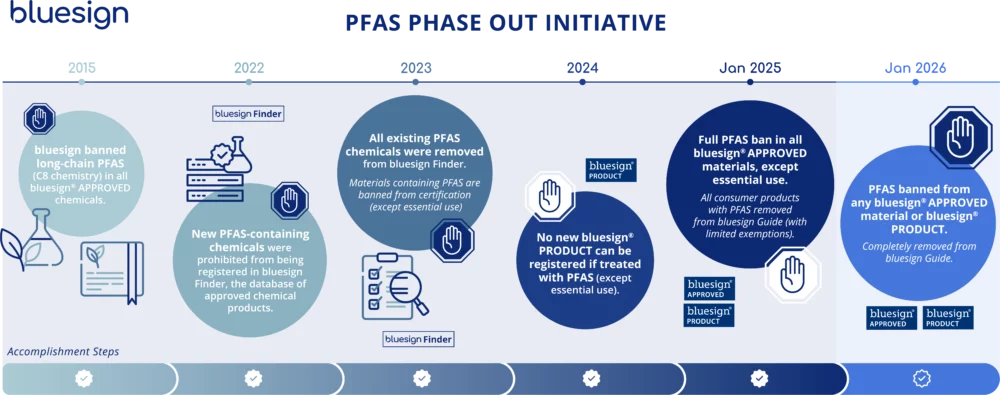
bluesign’s PFAS Phase-Out Timeline

PFAS phase-out timeline

  • 2015: bluesign restricted long-chain PFAS (C8 chemistry) in all bluesign-assessed products.
  • 2022: New PFAS-containing chemicals were prohibited from registration in bluesign Finder, the database of assessed chemical products.
  • 2023: All existing PFAS chemicals were removed from bluesign Finder and excluded from assessment.
  • 2024: No new bluesign® PRODUCT could be registered if treated with PFAS (except essential use).
  • January 2025: Full PFAS restriction in all bluesign® APPROVED materials, except essential use. All consumer products treated with PFAS were removed from bluesign Guide (with limited exemptions).
  • January 2026: PFAS restricted in any bluesign® APPROVED material or bluesign® PRODUCT (now known as bluepass). Completely removed from both bluesign Finder and Guide.

This timeline reflects bluesign’s science-based approach to managing harmful substances, supporting both industry compliance and long-term environmental and consumer safety.

For consumers, the bluesign® PRODUCT label indicates that a product was made with materials assessed against bluesign’s Criteria, which include restrictions on PFAS. It provides a reference point for identifying products made with independently assessed inputs.

The Future of PFAS-Free Fashion

Consumer demand for products made without persistent chemicals continues to grow, and the regulatory environment is accelerating to match. Brands that invest in proactive chemical management now will be better positioned as requirements expand across markets.

By working with bluesign, manufacturers, brands, and retailers can align their supply chains with robust standards for chemical safety, transparency, and regulatory readiness.

Learn more about how bluesign’s chemical management system supports the textile industry, or contact us your supply chain needs.

Frequently Asked Questions About PFAS in Clothing

Are PFAS banned in clothing?

It depends on where the product is sold. As of 2026, several U.S. states (including California, New York, Maine, Vermont, and Connecticut) and European countries (France and Denmark) have enacted bans or restrictions on PFAS in consumer textiles. Several EU-wide restrictions on specific PFAS groups are in force or will take effect in April 2026 (PFHxA). The regulatory landscape continues to evolve.

Why are PFAS used in clothing?

PFAS provide water, oil, and stain resistance that is difficult to replicate with other chemistries. They’ve been widely used in outdoor gear, activewear, and performance textiles for decades. However, their environmental persistence and potential health effects have driven regulators and brands to seek alternatives.

What are the alternatives to PFAS in textiles?

There is a wide range of waterborne products available on the market, including polyurethane-based, polyacrylate-based, wax-based, and silicone-based repellents. They are applied using the same equipment as conventional PFAS treatments. Performance varies by chemistry, application method, and fabric construction.

How does bluesign address PFAS?

bluesign has progressively restricted PFAS across its system since 2015, beginning with long-chain PFAS (C8 chemistry) and completing a full restriction by January 2026. bluesign’s approach manages chemistry at the input stage, helping manufacturers and brands reduce reliance on PFAS while maintaining product performance.

Daniel Waterkamp

Reviewed by Dr. Daniel Waterkamp

Head of bluesign AcademyPh.D. Process Engineering

This article was reviewed by Daniel Waterkamp, a chemical engineer and sustainability professional with a PhD in process engineering. As Head of bluesign Academy, Daniel oversees chemical compliance for international brands and helps develop safer, sustainable solutions for the textile industry. His expertise ensures the accuracy and relevance of the information presented.

Categories