What It Really Takes to Make a Responsible Jacket
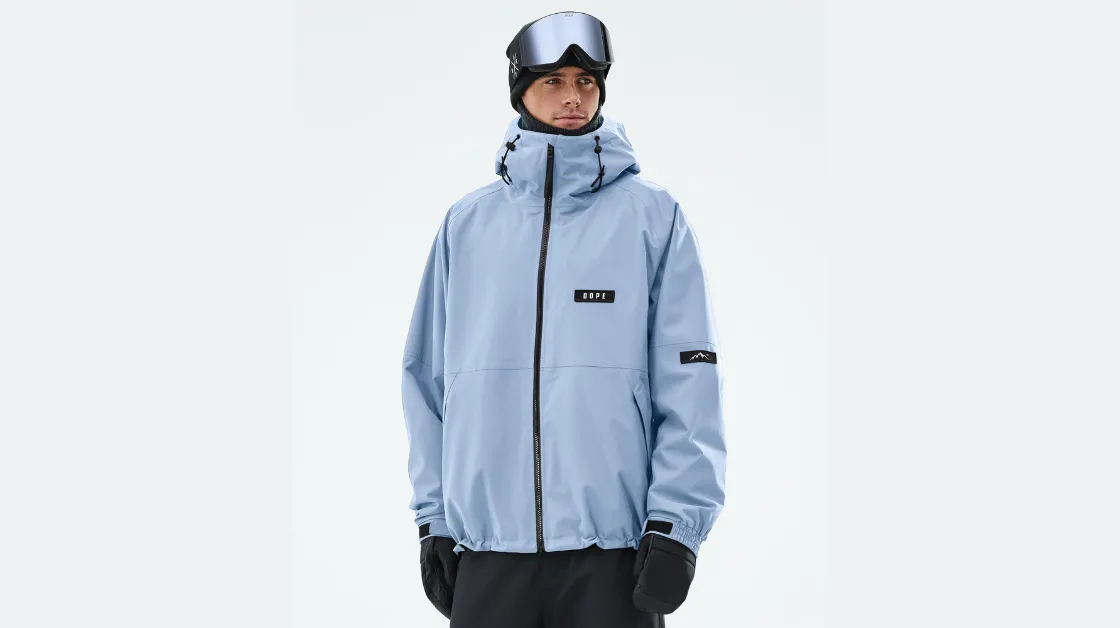
Ridestore, a Swedish technical outerwear brand and bluesign System Partner, set out to do exactly that. This is the story of what that process looks like in practice, what it requires from the brand and its supply chain, and where the bluesign System fits in.
More than the fabric
Most conversations about responsible production focus on the base material. Recycled content gets the headline. But for technical outerwear, the base fabric is only one piece. A ski jacket needs to repel water, block wind, breathe, flex with movement, and survive repeated use in harsh conditions. Achieving that requires layers of chemistry and engineering that most people never think about.
Ridestore’s Spartan jacket, for example, uses a mechanically recycled stretch polyester as its base fabric. But the jacket also includes a TPU membrane for waterproofing, a durable water repellent (DWR) finish with no intentionally added PFAS, lamination adhesives, coated trims, heat-transfer labels, and more. Every one of those components involves chemical inputs.
“Everybody thinks about product impact being in the recycled fibers or in the final product, but it is actually a lot more than that.” Ashish Ahlawat, Head of R&D, Ridestore, Dope and Montec
This is the gap the bluesign System is designed to address. Rather than testing the finished product at the end, bluesign works upstream, helping brands and their suppliers manage chemical inputs, production processes, and environmental impact at the source.
A narrower path, taken intentionally
Choosing to build products within a system like bluesign means accepting trade-offs. The pool of available suppliers is smaller. Not every facility has invested in the chemical management systems, worker safety infrastructure, and environmental controls that the bluesign System requires. That narrows the options.
But for Ridestore, a narrower field of suppliers is a feature, not a limitation.
“When you have environmental considerations and chemical safety built into your product creation process, your pool of suppliers is not as wide. But it is wide enough that we can create the best looking garments, in the highest quality, without sacrificing the environmental or the safety concerns.” Ashish Ahlawat, Head of R&D, Ridestore, Dope and Montec
Ridestore’s goal was not just to source one component responsibly. The brand set out to have every facility in its supply chain onboarded into the bluesign System. That means the weavers, the dyers, the laminators, and the trim suppliers all working within the same framework for chemical management and environmental performance.
“Many of Ridestore’s partners within the supply network had already been part of our system. So we stepped in and supported onboarding the remaining facilities and other players in the network.” Antje Fehling, Head of bluesign Brand Services
What people do not see
The details that make a jacket responsible are mostly invisible to the person wearing it. Snaps need to be coated. Zippers involve chemical treatments. Lamination requires adhesives. A cord has its own material composition. None of these components show up in a product description, but each one involves decisions about chemistry, sourcing, and supplier capability.
Ridestore approaches these details the same way they approach the shell fabric. Every high-impact component, from the DWR finish to the trims, is sourced from suppliers operating within the bluesign System.
“We have bluesign® APPROVED prints. We have bluesign® APPROVED trims. They all look very good. You have to know your stuff. You have to know how to develop the material, who the suppliers are, and you need to have good relationships with them.” Ashish Ahlawat, Head of R&D, Ridestore, Dope and Montec
This is where the misconception about responsible sourcing often breaks down. People assume it means compromising on performance, aesthetics, or cost. Ridestore’s experience suggests otherwise: with the right supplier relationships and the right system in place, the constraints become manageable.
Testing to failure
Durability is a core part of responsible production. A jacket that falls apart after one season, no matter how carefully its chemistry was managed, creates waste. Ridestore tests all materials to failure, both during development and in production, to confirm that performance holds up under real conditions.
For the Spartan jacket, that includes bond strength testing on the TPU membrane lamination, water repellency testing on the DWR-treated fabric, and stress testing on coated trims. The results must meet Ridestore’s standards before any material enters production.
“We test all materials to failure, both in development and in actual production. The supplier knows what they are doing, and we know what to ask for.” Ashish Ahlawat, Head of R&D, Ridestore, Dope and Montec
Water repellency, in particular, has been a focus for the industry as brands move away from PFAS-based DWR chemistry. The Spartan jacket achieves strong water repellency using non-PFAS alternatives, demonstrating that performance and reduced chemical risk can coexist. For more on how the industry is navigating this transition, see bluesign’s approach to PFAS in textiles.
What bluesign actually does
From the outside, bluesign can look like a label on a finished product. From the inside, the work happens much earlier. bluesign assessors visit manufacturing facilities to evaluate chemical management practices, environmental controls, worker health and safety systems, and input management. The process is not pass/fail; it is continuous improvement, supported by expertise and data.
For brands like Ridestore, the bluesign System provides something that would be difficult and expensive to build independently: verified visibility into what is happening across the supply chain.
“Without bluesign help, we are a bit blindsided. We don’t know what chemistry the supply chain uses and how they are using it. Whereas with bluesign, we can move ahead with confidence, knowing that the supply chain is not causing any unnecessary harm to the people or to the environment.” Ashish Ahlawat, Head of R&D, Ridestore, Dope and Montec
That visibility spans three dimensions: environmental impact (what the manufacturing process puts into the air, water, and waste streams), consumer safety (what substances remain in the finished product), and worker health (how chemistry is handled on the production floor). These are assessed and managed as a system, not as separate checkboxes.
The harder way, and why it is worth it
Building a responsible product through a system like bluesign is more work than the alternative. It takes longer. It requires deeper relationships with suppliers. It limits choices. And it demands ongoing commitment, because bluesign is not a one-time certification; it is a process of continuous assessment and improvement.
But for Ridestore, the investment provides something tangible: confidence that the products they bring to market are backed by verified data and managed chemistry, not just good intentions.
“The process is long. It’s hard work. But it gives us confidence that what we are putting in the market meets the highest standards.” Ashish Ahlawat, Head of R&D, Ridestore, Dope and Montec
A responsible jacket is not defined by one material choice or one label. It is the sum of hundreds of decisions made across the value chain, from the chemical supplier to the weaving mill to the laminator to the trim factory. When those decisions are made within a structured, independently verified system, the result is a product that performs for the wearer, protects the people who made it, and reduces the impact on the environment.
That is what it really takes.
Learn more about how the bluesign System supports responsible production across the textile value chain.
FAQs
Q: Is the Ridestore Spartan jacket PFAS-free?
Ridestore states that the Spartan jacket contains no intentionally added PFAS in its DWR (durable water repellent) finish. This means PFAS-based chemicals were not used in the formulation. Trace-level contamination from environmental sources cannot be fully excluded in any product.
Q: How is bluesign different from other sustainability labels?
bluesign is a system, not a single certification mark. It works upstream with chemical suppliers, manufacturers, and brands to manage inputs and processes across the value chain. This is different from end-product testing approaches that only evaluate the finished item.
Q: Does bluesign guarantee a product is safe?
bluesign does not make consumer health or safety guarantees. The system supports safer chemical management by verifying that facilities manage restricted substances, follow science-based criteria, and continuously improve their environmental and safety performance.

Reviewed by Barbara Oswald
Chief Commercial OfficerThis article was reviewed by Barbara Oswald, a commercial strategy and partnerships leader with more than 25 years of experience in the textile industry. As Chief Commercial Officer at bluesign, Barbara oversees global commercial strategy, brand partnerships, and responsible growth initiatives. Her expertise in supply chain operations and customer engagement ensures the accuracy and practical relevance of the information presented.
You might be interested in the following articles
The revised bluesign Criteria and Scheme are open for public consultation
The revised bluesign Criteria and Scheme are open for public consultation until 30 October 2026. Read the documents and tell us where we could improve.
Read more
bluepass and the EU Empowering Consumers Directive
How bluepass meets the seven EmpCo requirements for certification schemes from 27 September 2026, and what it means for bluesign System Partner companies.
Read more
EmpCo: What Brands Can Say From 27 September, and What They Cannot
The EU Empowering Consumers Directive becomes enforceable on 27 September 2026. What it prohibits, what it asks of certification schemes, and where to start.
Read more