Establishing Enzyme Safety Practices in Textile Manufacturing: Managing Worker Exposure Risks from Enzyme Dust

Enzymes have been used safely in industries such as detergent manufacturing for decades. In textile production, however, safety practices for managing airborne enzyme exposure remain limited or inconsistent, even though the occupational health risks have been well understood for years. Preventive, system-based approaches are critical to protecting workers, consumers, and the environment.
Enzyme dust and occupational exposure risk
Enzymes are proteins. When inhaled, enzymes can act as respiratory sensitizers and may lead to respiratory allergy or even asthma following repeat exposures if risk is not well managed. Solid enzyme products, particularly fine powders, can release airborne particles that are difficult to contain during handling steps such as dosing, transfer, and mixing.
This tendency to generate inhalable airborne particles is described as dustiness. Industry guidance developed by the Association of Manufacturers and Formulators of Enzyme Products (AMFEP) explains that dustiness, together with enzyme concentration, is a key determinant of inhalation exposure risk. Importantly, exposure occurs not because enzymes are inherently unsafe, but because airborne release can occur during routine handling in production environments, especially when dusty products are used.
Why controlling airborne exposure can be challenging
Enzymes have been used safely in manufacturing and end-use products for many years for their performance and sustainability benefits. However, managing enzyme dust exposure is not always straightforward. While personal protective equipment plays an important role, industry guidance emphasizes that effective risk management also depends on process design, engineering controls, training, and workplace hygiene.
In many textile facilities, particularly smaller operations or those in regions with limited regulatory oversight, consistent, well-designed ventilation systems and exposure monitoring may not be in place. In these contexts, reliance on downstream controls alone can make airborne exposure difficult to manage in practice.
AMFEP’s industry guidelines therefore promote a structured, step-by-step approach to risk assessment and control across the value chain, including when air measurements should be conducted and when additional preventive measures are needed.
Why upstream inputs and product design matter
One of the most effective ways to reduce occupational exposure risk is to address it upstream, before materials ever reach the production floor.
Industry guidance consistently highlights that product form and design influence dustiness and aerosolization potential. Reducing the likelihood of airborne release at the source is a key preventive strategy, especially in facilities where engineering controls may be limited.
From a worker-safety perspective, liquid enzyme formulations and encapsulated granules are less likely to generate airborne dust than fine powder formats. These formats reduce or eliminate the powder-handling steps where inhalation exposure typically occurs. This illustrates a broader principle in chemical management: product form and upstream decisions can significantly influence real-world exposure risk.
This approach reflects a shift beyond evaluating only final products and instead focusing on upstream inputs, verified primary data, and system-level controls to manage risks earlier in the value chain.
When safety and quality risks overlap
Worker health risks are not the only consideration. In textile finishing, the factors that influence worker exposure can also affect process consistency and product quality. Powder-based enzyme formulations, for example, may not dissolve evenly in water, which can lead to localized over-concentration during application. This can result in uneven treatment effects, such as streaking or frosty appearances, and in some cases fabric damage in areas exposed to higher enzyme levels.
From an operational perspective, these inconsistencies can increase rework, waste, and variability on the production floor. By contrast, liquid enzyme formulations allow for more uniform dosing and are more compatible with automated dosing systems and closed-system configurations, helping reduce variability in application while also limiting worker exposure. This illustrates how upstream decisions about input form and process design can simultaneously influence worker safety, product quality, and overall manufacturing efficiency.
Managing enzyme safety through a system approach
Across much of the global textile industry, enzyme safety practices have not yet fully aligned with established best practices in more mature industries. Product formats and the use of a “hierarchy of controls” that reduce enzyme dust exposure remain less common across the textile sector. Voluntary systems and industry guidance play a critical role in closing the gap. For example, AMFEP has published an enzyme safety guidance document specifically for the textile processing industries that outlines best practices for managing enzyme exposure.
Certification bodies can play an important role in advancing enzyme safety practices and supporting the adoption of product formats that reduce exposure potential.
More than a decade ago, bluesign identified airborne enzyme dust as a relevant occupational health risk and integrated this understanding into its system requirements. As a result, the use of powder enzyme products is not permitted in the manufacturing of bluesign® APPROVED materials or bluesign® PRODUCT. This decision reflects a preventive, science-based approach focused on upstream risk assessment rather than reliance on downstream testing alone.
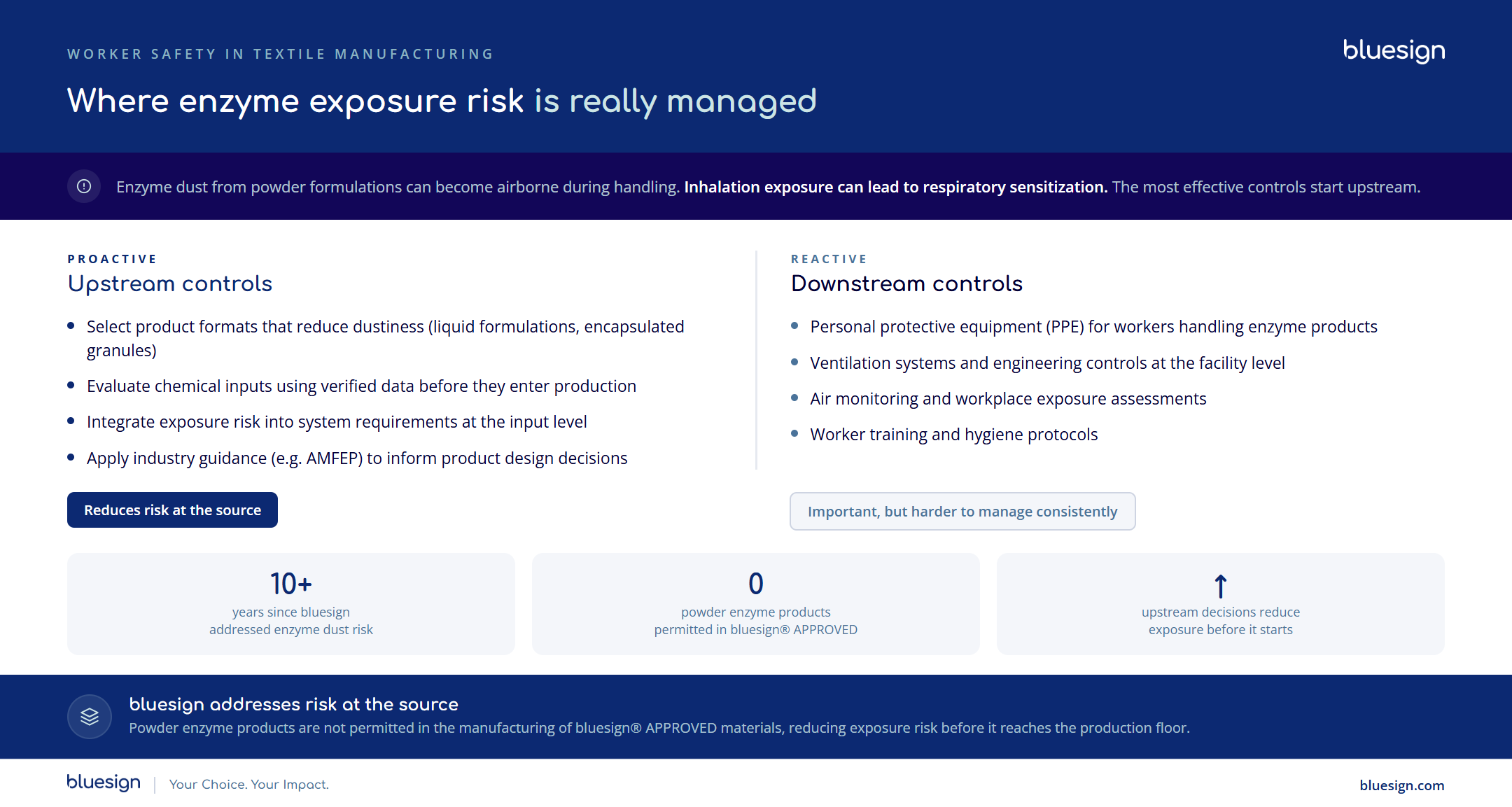
To support practical implementation, the bluesign System also provides transparency around chemical inputs through tools such as the bluesign Finder, enabling manufacturers and brands to identify enzyme formulations that align with these requirements. This pairing of risk identification with clear pathways to safer inputs is a core element of system-based chemical management.
“The occupational health risks associated with enzyme dust have been well understood for many years,” says Petr Valenta. “Fine enzyme powders can become airborne during handling, and inhalation exposure can lead to respiratory sensitization. Because controlling this exposure is often difficult in real production environments, bluesign addressed this risk early on by mandating the use of liquid enzymes as an alternative to the use of the powdered ones.”
By anticipating enzyme safety gaps and acting on verified data and industry guidance, system-based approaches help shift the industry from reactive compliance to proactive protection, safeguarding workers while supporting environmental responsibility and more stable, predictable operations over time.
Contact us to learn more about chemical risk in your supply chain.

Reviewed by Dr. Petr Valenta
Expert Chemical Substance Evaluation at bluesign AcademyPh.D. Organic ChemistryPetr is an Expert in Chemical Substance Evaluation at the bluesign Academy, specializing in consumer, environmental, and occupational safety across textile manufacturing and supply chains. He focuses on chemical hazard evaluation and risk assessment to support safer and more sustainable production.
With 15 years of experience in textile and chemical R&D and manufacturing, Petr works closely with manufacturers and brands on chemical safety, sustainable manufacturing, and regulatory compliance.
You might be interested in the following articles

China Now Judges Textile Wastewater by Whether Fish Embryos Survive It
China now tests textile wastewater on fish embryos. What GB 4287-2026 requires, who it covers, and what brands should ask suppliers before 2028.
Read more
The revised bluesign Criteria and Scheme are open for public consultation
The revised bluesign Criteria and Scheme are open for public consultation until 30 October 2026. Read the documents and tell us where we could improve.
Read more
bluepass and the EU Empowering Consumers Directive
How bluepass meets the seven EmpCo requirements for certification schemes from 27 September 2026, and what it means for bluesign System Partner companies.
Read more