China Now Judges Textile Wastewater by Whether Fish Embryos Survive It
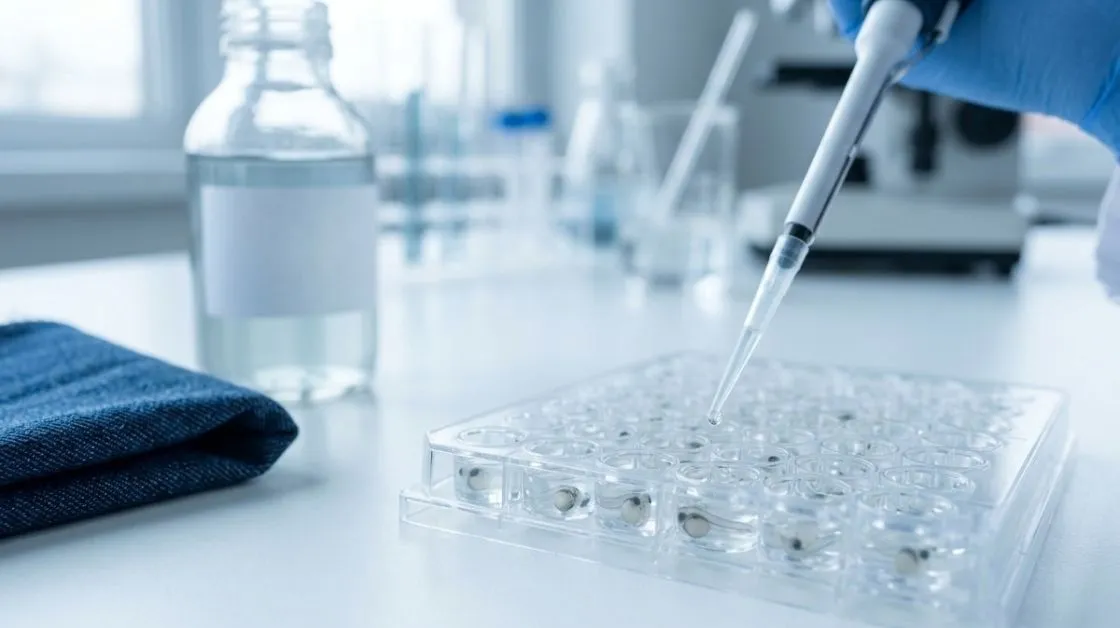
The rule marks a shift in how textile wastewater is judged, from counting substances to measuring their combined effect on living things. It also exposes a practical truth for every mill and brand: a toxicity test can show that treated water is harmful, but not why. Finding the cause, and preventing it, depends on how well chemical inputs, wastewater treatment and monitoring work together.
Key takeaways
- China’s national textile wastewater standard, GB 4287-2026, adds a fish egg toxicity limit for dyeing and finishing plants that discharge directly into water bodies.
- New plants must comply from 1 September 2026, existing plants from 1 January 2028.
- bluesign has required fish egg toxicity testing from directly discharging chemical suppliers for more than a decade. The draft bluesign Criteria, open for feedback until 30 October 2026, propose extending an annual ecotoxicity requirement to directly discharging textile manufacturers.
- A failed toxicity test signals a problem without naming it. Input control, wastewater treatment, testing and root-cause analysis each play a part in finding and preventing the cause.
What China’s new textile wastewater standard requires
In June 2026, China’s Ministry of Ecology and Environment (MEE) and the State Administration for Market Regulation published GB 4287-2026, the Discharge Standard of Water Pollutants for Textile Industry. It replaces four 2012 standards for dyeing and finishing, silk reeling, wool, and hemp, and extends coverage to chemical-fiber weaving and industrial textile products. New, rebuilt, and expanded facilities must comply from 1 September 2026. Existing facilities follow from 1 January 2028, or earlier where a provincial government approves it.
The standard tightens several rules. New dyeing and finishing plants, for example, may no longer send wastewater to municipal treatment plants. The change with the widest reach is a new line in the limit table: acute toxicity to zebrafish eggs.
The test works like this:
- The laboratory dilutes a sample of treated wastewater so that it makes up one-sixth of the test solution.
- Newly fertilized zebrafish eggs (embryos) are kept in that solution for 48 hours at 26°C.
- At least 90% of the embryos must survive.
- Dischargers under the strictest permit management test at least twice a year. All others test at least once a year.
Who has to test
The limit applies to direct discharge, meaning treated water released straight into a river, lake, or other water body, from two types of site:
- dyeing and finishing operations, excluding purely physical finishing
- shared treatment plants built specifically for the textile industry
Mills in industrial parks that send wastewater to a shared treatment plant are not tested at their own outlet under this limit; the test happens further down the pipe, at the textile-industry plant. Mixed-industry treatment plants are not listed under the fish egg toxicity limit. For anyone mapping a supply chain, that distinction decides who is responsible for the result.
Why regulators are testing effect, not only substances
Conventional limits measure one parameter at a time: chemical oxygen demand (COD), ammonia, phosphorus, a named metal. Each result says how much of that substance is present. None says how the full mixture behaves once it reaches a river, where substances interact, break down, and sometimes become more harmful together than apart.
Whole-effluent toxicity testing closes that gap. Instead of asking what is in the water, it asks what the water does to a living organism, including the effects of substances no one thought to measure. In its official Q&A on the standard, the MEE said earlier textile standards lacked an overall toxicity control for dyeing and finishing wastewater, the higher-risk stream. Fish egg toxicity now works alongside the chemical limits, not in place of them.
From German practice to a global test guideline
The method has a long track record, and much of it runs through Germany. The German Wastewater Ordinance replaced its fish toxicity test with a test for toxicity to fish eggs in 2004, and its textile annex still sets a fish egg toxicity limit. The same year, the OECD took up a fish embryo test for chemicals with Germany as lead country, and a draft guideline was presented in 2006. In 2013, the OECD adopted Test Guideline 236, the Fish Embryo Acute Toxicity (FET) Test, designed as an alternative to acute toxicity tests on adult fish.
What is new is the reach. One of the world’s largest textile producing countries has made a fish egg toxicity limit part of routine permit compliance for dyeing and finishing.
A failed test is a signal, not a diagnosis
A failed fish egg toxicity test shows that the treated effluent has an acute biological effect under the test conditions. It does not identify the responsible substance or process. The cause may be a production chemical that has passed through treatment, a transformation product formed during production or treatment, or a problem with the design or operation of the wastewater treatment system.
This is what sets toxicity testing apart from testing a finished product for restricted substances. A product test looks for named substances. A toxicity test measures the overall biological effect of a sample, so on its own it cannot say which substance is responsible, confirm whether a production chemical caused it, or show where in the process the problem started.
Chemical input management, wastewater treatment, toxicity testing and root-cause analysis therefore play different but complementary roles. Input control reduces the entry of known hazardous substances into wastewater. Properly designed and operated treatment reduces contaminants before discharge. Toxicity testing checks the combined acute effect of the final effluent, while root-cause analysis identifies the source of a failure and guides corrective action.
The draft bluesign Criteria bring these elements together through chemical input management, controls on discharges of critical chemicals, raw and treated wastewater monitoring, wastewater treatment performance, and root-cause analysis and corrective action when problems occur. Together, they connect prevention, treatment, verification and response rather than relying on end-of-pipe testing alone. We explored the same logic in Water at Mills: What Goes In Decides What Comes Out.
bluesign has required fish egg toxicity testing for years. The draft Criteria go further.
bluesign has required fish egg toxicity testing for more than a decade from chemical suppliers that discharge treated wastewater directly into water bodies. The current version of the requirement is part of the 2020 chemical supplier requirements. These suppliers make the dyes and auxiliaries textile mills use, so the requirement sits at the very start of production. What GB 4287-2026 introduces as new for China’s textile industry has been established practice for bluesign’s chemical industry partners.
What the draft proposes
The revised bluesign Criteria, open for public consultation until 30 October 2026, propose a broader ecotoxicity framework for production sites that discharge treated wastewater directly into water bodies:
- Wider scope. The requirement would cover yarn and textile manufacturing and consumer product manufacturing with wet processing, including denim, alongside chemical suppliers. For textile manufacturers, it applies to sites discharging more than 5 m³ of wastewater a day.
- Annual testing through an accredited laboratory.
- A four-tier cascade. Fish egg toxicity is the default. A site may move to water fleas (daphnia), then algae, then bacteria, each with its own limit, only when testing at the higher level of the food chain is not reasonably available.
For fish egg toxicity, the draft limit is no observed toxicity at a dilution factor of 6, the same threshold as GB 4287-2026, and the draft lists China’s own test method (HJ 1069) alongside OECD 236 and ISO 15088.
Why a four-tier cascade matters
A national standard specifies a test for one country. bluesign Criteria apply to System Partner sites in many countries, and the draft recognizes that fish egg toxicity testing may not be available through an accredited laboratory everywhere. The cascade means a directly discharging site does not fall outside the requirement because one test is unavailable locally; it moves to the next organism instead.
If the draft is adopted, a biological wastewater test that national rules already require in China and Germany would also apply to directly discharging System Partner sites in countries where national law does not require it.
“The bluesign Criteria address chemical inputs and wastewater treatment, but these controls alone cannot show the combined biological effect of the final effluent,” says Sumit Sarker, Sustainable Textile Expert at bluesign Academy. “Whole-effluent toxicity testing adds a final biological check that the treated wastewater does not cause unacceptable acute toxicity.”
What brands sourcing from China should ask now
For brands, the useful question is not whether a supplier passed once. It is whether the supplier can find and fix the cause when a result goes wrong. Existing plants have until January 2028, and many will test effluent toxicity for the first time. Five questions help separate a plan from a hope:
- Where does your wastewater go? Directly to a water body, to a textile-industry treatment plant, or to a mixed-industry plant?
- Have you run a fish egg toxicity test yet? If you discharge directly, which accredited laboratory did it, and what did it show?
- What happens if a test fails? Is there a defined process to find the cause and correct it?
- Which chemical products drive your wastewater load? How many were assessed before use, for example as bluepass chemical products listed in the bluesign Finder?
- Who reviews treatment performance, and how often? A single passing result is a snapshot. Ongoing monitoring is a system.
System Partner mills are not starting from zero. They already work within bluesign wastewater limits, sampling plans that include measurements by accredited third-party laboratories, and chemical inputs assessed before they reach production, and have their wastewater treatment systems and operating controls reviewed during site assessments. Together, these measures provide an established foundation for meeting the new fish egg toxicity requirement.
Help shape the final Criteria
The draft bluesign Criteria are open for feedback until 30 October 2026. If you manage wastewater in textile or chemical production, read the drafts on the public consultation page and tell us where the ecotoxicity requirements could be clearer or more practical.

Written by Sumit Kanti Sarker
Sustainable Textile ExpertMaster’s degree in Chemical and EnergyRead full profile →You might be interested in the following articles

The revised bluesign Criteria and Scheme are open for public consultation
The revised bluesign Criteria and Scheme are open for public consultation until 30 October 2026. Read the documents and tell us where we could improve.
Read more
bluepass and the EU Empowering Consumers Directive
How bluepass meets the seven EmpCo requirements for certification schemes from 27 September 2026, and what it means for bluesign System Partner companies.
Read more
EmpCo: What Brands Can and Cannot Say Under the New Rules
The EU Empowering Consumers Directive is now enforceable. What it prohibits, what it requires of labels, and how to bring your claims into line.
Read more